


RBI-licensed credit bureaus in India, and each one scores you separately
Home / Credit score
Check your credit score
from multiple bureaus
See your CIBIL, Experian and CRIF High Mark scores in one place and track how they move month after month. GoodScore reads the report behind each score, explains it in plain words and shows you what to fix first. Checking your own score never lowers it.
- Your CIBIL, Experian and CRIF High Mark scores side by side, updated monthly
- Your full report explained account by account, including on video
- Answers from GoodScore AI by chat, call or video, based on your own report
Last reviewed: 04/11/2026
620 Good · CIBIL
6-month trend
+18GoodScore AI
Paying ₹18,000 before your statement date would bring card utilisation under 30%.1 Crore+ downloads on Google Play
4.7 / 5 8.5 lakh+ Google Play reviews · 65K App Store ratings
Bureau data
- TransUnion CIBIL
- Experian
- CRIF High Mark
Security
- PCI DSS
- ISO
- SOC 2
1 crore+ downloads on Google Play · 8.5 lakh+ Google Play reviews · 65K App Store ratings. Ratings as listed on Google Play and the App Store. GoodScore is free to download; some features may need a paid plan.
Credit score basics
What is a credit score?
Think of your credit score as your borrowing record condensed into one number between 300 and 900. Every EMI you have paid, every card bill, every late payment and every loan application feeds into it. A credit bureau builds the number from your credit report, and it changes as the report changes.
When you apply for a personal loan, home loan or credit card, your score is usually the first thing a lender looks at. A strong score can mean a quicker yes, a lower interest rate or a higher limit. A weak one can mean a rejection or costlier terms. It is never the whole story, though. Lenders also weigh your income, your existing EMIs, your job and their own policies.
Check your score freeEvery bureau must give you one full report with your score, under RBI rules
Points you lose by checking your own score, however often you look
Built from your credit report
- Loans
- Credit cards
- Repayment record
- Recent applications
Lenders also check
- Income
- Existing EMIs
- Employment
- Lender policy
What your credit score does not include
- Salary
- Bank balance
- Investments
- UPI and debit card spends
What is a CIBIL score?


- Equifax

A CIBIL score is the credit score calculated by TransUnion CIBIL, the oldest of India’s four RBI-licensed credit bureaus. The other three are Experian, Equifax and CRIF High Mark. All four use the same 300 to 900 range, but each builds its score from the data lenders send it, using its own model.
Because CIBIL came first, “CIBIL score” has become the everyday name for any credit score, and many loan forms still ask for it by that name. Scores from different bureaus usually sit close together but rarely match exactly, which is why GoodScore shows your CIBIL, Experian and CRIF High Mark scores side by side.
Score ranges
What is a good credit
score in India?
Most lenders treat 750 and above as a good score, whichever bureau it comes from. Between 650 and 749 you will still find lenders willing to approve you, though the sharpest interest rates tend to go to higher scores. There is no official cut-off. Each lender sets its own bar, and it can differ by product, so the same score might get a home loan approved and a premium credit card declined.
Good
650–749
Most doors are open
Many lenders will approve you. The very best rates usually still go to borrowers above 750.
A sensible next step Keep card use low and leave your oldest accounts open.
These bands are a simplified guide from GoodScore’s editorial team. Each bureau uses its own model and labels, and each lender sets its own approval thresholds.
What moves your score
Factors that affect your
credit score and CIBIL score
No bureau publishes its exact formula, and the four models differ in the detail. But the same five things drive every score. Here they are, roughly in order of weight.
Payment history
Whether you have paid every EMI and card bill on time. This is the biggest single influence on your score. A late payment shows on your report as DPD, or days past due, and a default, settlement or write-off can weigh on your score for years.
What helps Paying in full and on time, every month. Autopay and reminders take the risk out of it.
What hurts Late or missed payments, and any account marked settled or written off.
DPD 30/60/90 explainedOther things that can pull your score down
Standing guarantor for a loan that goes unpaid, an error on your report such as a loan you never took, and taking several small short-term loans close together.
GoodScore shows which of these is moving your score, account by account.
Why GoodScore
AI Credit Intelligence:
more than a credit score
A number on its own does not tell you much. GoodScore’s AI Credit Intelligence goes through every account on your report, tells you in plain words why your score moved, and points you to the one or two things worth doing next.
Track how your score moves
With your permission, GoodScore pulls your CIBIL, Experian and CRIF High Mark data every month. When a score moves, you see which account caused it, well before a lender points it out.
Your report, walked through on video
A credit report can run to pages of codes. GoodScore walks you through yours on video, account by account, so DPD, settled and utilisation stop being jargon.
Ask GoodScore AI, by chat, call or video
Ask the questions you would ask a friend who works at a bank. Why did my score drop? Which card should I pay first? Is that old loan still hurting me? Every answer comes from your own report.
Stay ahead of due dates
All your EMIs and card bills in one place, with reminders before each due date and the option to pay eligible bills through Bharat Connect, NPCI’s bill payment system. One missed payment can undo months of good work.
A plan for overdue accounts
If you have fallen behind on a loan, GoodScore can help you understand your options and plan a way out, including what closing, settling or leaving an account means for your score. This is a paid service. You can always speak to your lender directly at no cost.
Explore loans when you are ready
When you are ready to borrow, compare personal loan offers from GoodScore’s lending partners in the app. Approval, amount and rate always depend on the lender’s own assessment.
How it works
How to check your credit score
online with GoodScore
All you need is your phone and a few minutes. Checking is a soft enquiry, so it never touches your score.
 1
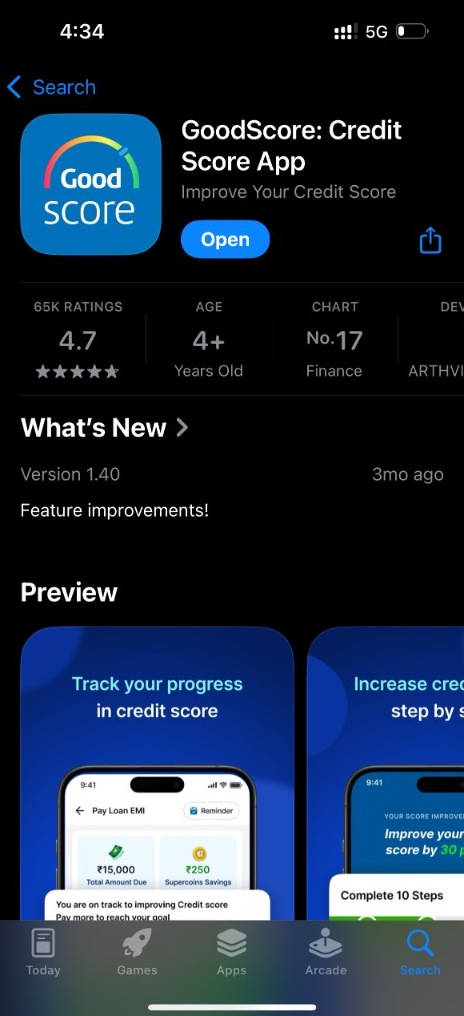
Get the app
Download GoodScore from Google Play or the App Store.
 2
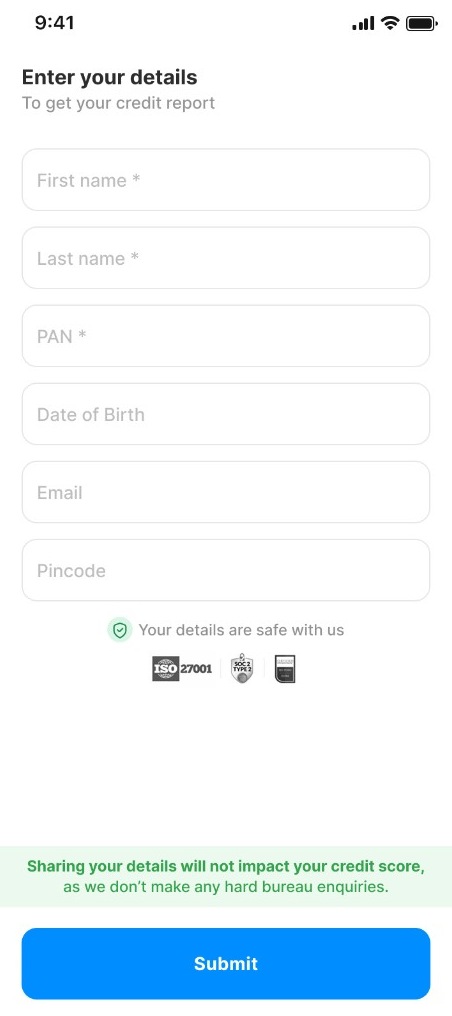
Verify and consent
Confirm your mobile number with an OTP, check the details the bureau uses to find your record, and give GoodScore permission to fetch your report.
 3
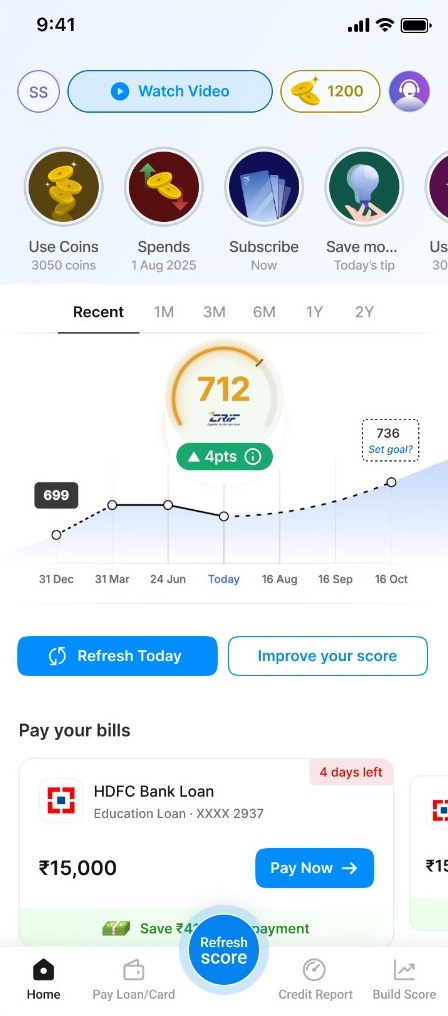
See your scores and report
Your CIBIL, Experian or CRIF High Mark scores appear with every account behind them, and what is pushing each score up or down.
 4
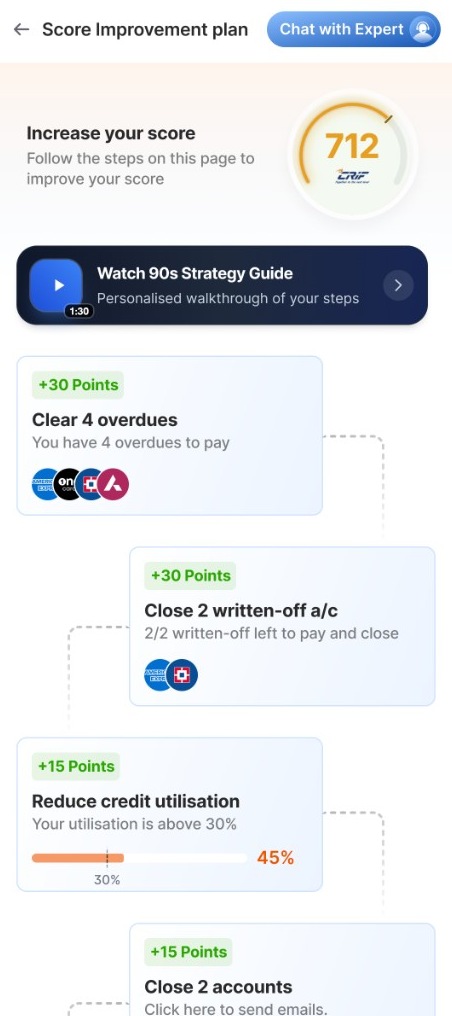
Follow your plan
Work through your steps and watch the monthly updates. Changes show only as lenders report your new behaviour, so give it time.
Can I check my CIBIL score with just my PAN?
Not with PAN alone. Your PAN is how the bureaus find your record, so you will always need it, but you will also confirm the name and date of birth your loans and cards were opened with and verify the linked mobile number with an OTP. Any genuine app or website asks for that OTP first, and none can show you someone else’s score without their consent.
Free report vs monthly tracking
RBI rules entitle you to one free full credit report a year, score included, from each of TransUnion CIBIL, Experian, Equifax and CRIF High Mark. That annual report is a useful snapshot. Monthly tracking on GoodScore shows which way you are heading and flags a wrong entry while there is still time to fix it before a loan application. Read: How to check your CIBIL and CRIF reports online
Score not showing? If you have never had a loan or card, or your first one is only a few months old, the bureau may not have enough history to score you yet. That is common, and it changes with time. Read: NH/NA credit score explained
Inside the app
How GoodScore AI Credit
Intelligence works
Report analysis
Credit card ···482164% used
Limit ₹1,20,000Balance ₹76,800
Personal loanOn time
1 late payment (DPD 30)Mar
Hard enquiries (6 mo)2
Every loan and card on your report, with its utilisation, payment record and enquiries laid out in one view.
GoodScore AI
Why did my score fall 12 points this month?
Mainly because your card balance climbed to 64% of its limit. A new loan enquiry on 4 September added a little.
Want a plan to get that card under 30%?
Straight answers by chat, call or video, drawn from your own report.
Upcoming payments
Home loan EMIDue 5 Nov · ₹24,350
Credit card billDue in 3 days · ₹18,000
Two-wheeler loanDue 12 Nov · ₹3,120
Pay via Bharat Connect
Every EMI and card bill in one calendar, with a nudge before each due date.
Your plan
Set autopay on card ···4821 Done
Bring utilisation under 30% ₹40,800 to go
Pause new loan applications For the next 3 months
A short list of steps, ranked by what will make the most difference to your score.
Checking without worry
Does checking your credit score
or CIBIL score lower it?
No. Checking your own score is a soft inquiry and has no effect, no matter how often you do it. Your score is only affected when a lender checks your report because you have applied for credit, which is called a hard enquiry.
Soft enquiry
You check your own score
- You, through GoodScore, a bureau website or another app
- As often as you like
- Not counted as an application
- Watch out for: nothing
Hard enquiry
A lender checks after you apply
- A bank or NBFC, after you apply
- Each time you apply for a loan or card
- Visible to other lenders
- Many in a short span can suggest you are short of money
Credit health
How to improve your
credit score, responsibly
Credit scores do not jump overnight. They improve as lenders report better behaviour, month after month, and how quickly depends on what pulled yours down.
Be careful with anyone promising a quick fix. Nobody can remove accurate negative information from your report. Only genuine errors can be corrected, and disputing them with the bureau or lender is free.
Pay every EMI and card bill on time
Nothing matters more. Set up autopay or reminders. If you cannot clear a card bill in full, pay at least the minimum due on time and plan to clear the rest.
Keep card utilisation low
Use less of your available limit, ideally under about 30%. Paying part of the bill before the statement date lowers the balance that gets reported.
Review your report for errors
A loan you never took, a closed account still showing as active or a late payment that was not late can all drag you down. Raise a dispute with the bureau that shows it.
Space out new credit applications
Each one can add a hard enquiry. Apply when you need credit and are likely to be approved, not to test the waters.
Keep old accounts in good standing
A long, clean history works in your favour, so think twice before closing your oldest card.
Borrow within a plan you can sustain
Before you take on a new EMI, check it fits comfortably alongside the ones you already pay.
How long does it take to improve?
High card balances
Often within one or two months of paying them down, as lenders now report several times a month
One recent late payment
Its weight fades over many months of on-time payments
Settled or written-off accounts
Recovery takes years, but steady payments on your other accounts still count
No credit history
A score usually appears around six months after you start using your first loan or card
Watch
How to read your credit report
(CIBIL report) in three minutes
Every credit report, whether from TransUnion CIBIL, Experian, Equifax or CRIF High Mark, has the same four parts. This short video shows what each one means and what a lender looks for.
What to check in each part
- Personal details Check your name and date of birth match your PAN exactly.
- Contact and employment Look for phone numbers or addresses you have never used.
- Accounts Look for loans you never took, closed loans still shown as active and late payments that were not late.
- Enquiries Look for applications you never made.
More explainers on the GoodScore YouTube channel.
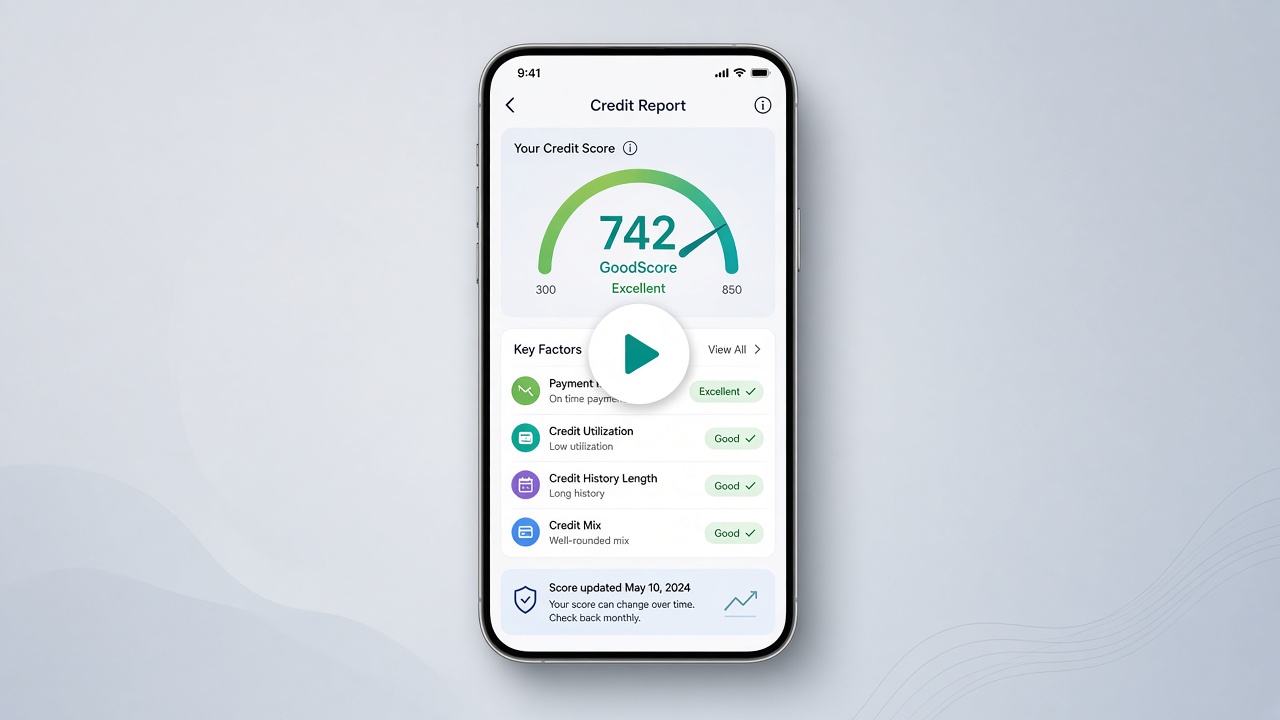 Reading your credit report, section by section
FAQs
Credit score questions,
answered
Still unsure? Ask GoodScore AI in the app, or write to help@goodscore.app.
A three-digit number between 300 and 900 that sums up how you have handled loans and credit cards. Credit bureaus work it out from your credit report, and lenders use it to judge how likely you are to repay on time.
750 or above is widely seen as good, whichever bureau the score comes from. Many lenders also consider scores from 650 to 749, often at slightly higher rates. Above 800 is excellent, and a perfect 900 is not needed. Each lender sets its own threshold.
Download GoodScore, verify your mobile number and give consent to fetch your report. You will see your CIBIL, Experian and CRIF High Mark scores together, updated every month. You can also download one free full report a year, score included, from each bureau’s website.
No. To check your credit score on GoodScore and to avail premium features, such as help with overdue accounts, AI overview of your credit report, etc. need a paid plan.
A CIBIL score is one type of credit score, calculated by TransUnion CIBIL. Experian, Equifax and CRIF High Mark each calculate their own on the same 300 to 900 scale. Your scores from different bureaus are usually close but rarely identical.
Credit Information Bureau (India) Limited. The company is now called TransUnion CIBIL Limited, and it is one of India’s four RBI-licensed credit bureaus.
You can check your CIBIL score on GoodScore, alongside your Experian and CRIF High Mark scores. TransUnion CIBIL also has to give you one free full report with your score every calendar year on its own website. Read: How to check your CIBIL and CRIF reports online
Your PAN is how bureaus match you to your record, so you will need it. You will also verify the mobile number linked to your credit accounts. Aadhaar alone is not enough. No genuine app or website will show someone else’s score without their consent.
No. Checking your own score is a soft enquiry, with no effect however often you check. Only a lender pulling your report after you apply for credit, a hard enquiry, can affect it.
Your score changes when something on your report changes. Since 1 July 2026, lenders report to the bureaus as on the 9th, 16th, 23rd and last day of each month, so a payment can show within a couple of weeks. GoodScore refreshes your score whenever you want.
Payment history matters most, followed by credit utilisation, the length of your credit history, recent applications for credit and your mix of secured and unsecured credit. Your salary, bank balance and investments are not part of your score.
Pay every EMI and card bill on time, keep card balances low, space out new applications, keep old accounts open and check your report for errors. Improvement shows over months, not days.
There is no fixed timeline. It depends on why your score is 600. If high card balances are the cause, it can improve within a few months of paying them down. If there is a default or settlement on your report, expect a longer climb of a year or more.
It means the bureau does not have enough credit history to calculate a score. It is not a bad score. A score usually appears about six months after you start using your first loan or credit card, and paying on time from the first month builds a strong start.
Each bureau has its own scoring model, and lenders’ updates can reach the bureaus on slightly different days. A gap of a few points is normal. A big gap usually means one report has different or wrong information, and it is easy to spot on GoodScore because your CIBIL, Experian and CRIF High Mark scores sit side by side.
GoodScore uses your credit information only to show your scores, explain your report and build your plan. You can withdraw your consent at any time. Read our Privacy Policy.
No. GoodScore shows your credit information from CIBIL, Experian and CRIF High Mark, with your consent. The bureaus calculate the scores based on their internal algorithm.
No. A good score improves your chances, but lenders also look at your income, existing EMIs, job and their own policies.
Reviews
What GoodScore users say
I had questions about how the process works. Support explained everything and suggested good options for my score. Thanks GoodScore for helping me — I’ll keep improving with your help.
I messaged GoodScore on WhatsApp about my credit report. They helped me file a dispute and shared useful tips. The team made me feel comfortable asking anything — thank you, GoodScore!
Awesome app for timely credit reports and loan offers from multiple lenders. If your score is decent, you can get a useful amount when you need it for an emergency.
These are individual experiences, not financial advice. You can read every review on Google Play and the App Store.
Learn more
Guides from the GoodScore blog
- How to check your credit score in India Credit score
- How to check your CIBIL score for free CIBIL
- How to check CIBIL and CRIF credit reports online in 5 minutes Credit reports
- RBI repo rate changes: how it affects your home loan EMI in India Home loans
- EPFO may allow PF withdrawals via UPI: what it means for employees in India EPFO
How we write
This page is educational and is not financial advice. We explain credit concepts using RBI and credit bureau material, avoid promising outcomes, and review the page when rules change. Spotted something wrong? Email help@goodscore.app.
Sources Reserve Bank of India directions to credit information companies (free full credit report, RBI/2016-17/58; credit information reporting, 2025; compensation for delayed correction, RBI/2023-24/72); TransUnion CIBIL, Experian India, Equifax India and CRIF High Mark.
About GoodScore
GoodScore is an AI credit management app operated by Arthvit 1809 Tech Pvt. Ltd., Bengaluru. GoodScore is not a credit bureau. It shows your credit information from the bureaus with your consent, which you can withdraw at any time.
Support: help@goodscore.app · +91 80656 63363
Grievances (lending): grievances@goodscore.app
6th and 7th Floor, Incuspaze Qube, Qube Software Park, Varthur Hobli, Bengaluru 560103
Know your score. Understand it.
Take the next step.
Get your CIBIL, Experian and CRIF High Mark scores, a walkthrough of your report and a plan built around it.