

Whenever the RBI announces a repo rate hike, borrowers across India start worrying about one thing: their costs. EMI. News headlines talk about higher interest rates, but most people are not sure what actions to take and when to take them.
The first 48 hours after a repo rate hike are essential. Timely steps can reduce the long-term impact on your EMI and overall loan cost. Let’s understand what to do in simple terms.
What Is Repo Rate and Why Does It Affect Your EMI
Repo rate is the rate at which banks borrow money from the RBI.
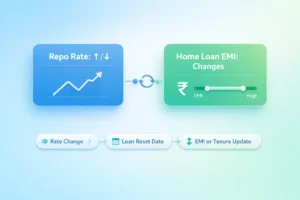
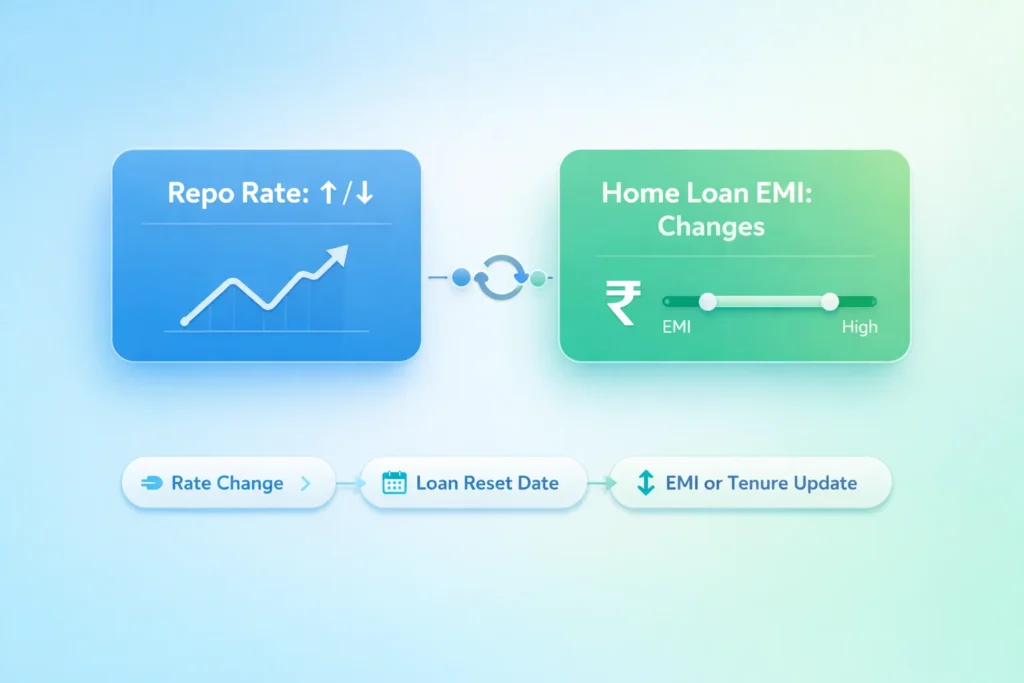
When the repo rate increases
- Banks’ borrowing cost increases
- Loan interest rates move up
- EMIs on floating rate loans increase
Home loans, personal loans, and business loans linked to floating rates are most affected.
Does Repo Rate Hike Affect All Loans Immediately
No.
The repo rate hike mainly affects.
- Floating rate home loans
- Loans linked to repo or RLLR
- Some business loans
Fixed-rate loans usually do not change immediately.
The first step is to determine whether your loan is affected.
Step 1: Check Your Loan Type Immediately
Within the first few hours, check
- Is your loan fixed or floating
- Is it linked to the repo or the older benchmark
- Current interest rate mentioned in the loan statement
If your loan is a floating rate, EMI or tenure will change.
Agar fixed hai, to thoda relief milta hai.
Step 2: Check How the Bank Adjusts EMI or Tenure
Banks usually adjust in two ways
- EMI increases, tenure remains the same
- EMI stays the same, tenure increases
Most Indian banks increase tenure first to keep EMI stable.
This sounds comfortable, but it increases total interest paid.
Step 3: Ask for Impact Illustration From the Bank
Within 24 hours, request an impact illustration from your bank.
This shows
- New interest rate
- Revised EMI
- Revised tenure
- Total interest increase
Seeing numbers clearly helps you decide the next move instead of guessing.
Step 4: Decide Whether to Increase EMI or Tenure
This is a key decision.
If you can afford slightly higher EMI
- Choose the EMI increase
- Keep tenure the same
- Save on long-term interest
If cash flow is tight
- Temporary tenure increase is okay
- Plan to reduce it later
Thoda extra EMI dena long term mein fayda karta hai.
Step 5: Make a Small Prepayment Early
Even a small prepayment within the first few months helps.
Why
- It reduces the outstanding balance
- Future interest is calculated on a lower amount
- EMI impact becomes smaller
You do not need a large amount. Even ₹50,000 or ₹1 lakh helps.
Step 6: Check Your Interest Benchmark
Many older loans are still linked to MCLR.
Repo-linked loans react faster but are more transparent. MCLR-based loans sometimes lag.
Check
- Current benchmark type
- Whether switching the benchmark is allowed
Moving to a better benchmark helps in the long run.
Step 7: Review Balance Transfer Option Carefully
After a repo rate hike, many banks push balance transfer offers.
Before switching
- Compare the new rate carefully
- Check processing fees
- Calculate actual savings
- Check reset clauses
A balance transfer makes sense only if the savings are real, not just on paper.
Step 8: Avoid Panic Decisions
Common mistakes people make after a rate hike
- Switching banks in a hurry
- Choosing a longer tenure blindly
- Ignoring long-term cost
- Not reading the loan statement
Calm analysis saves money.
Impact on Credit Score
The repo rate hike itself does not affect your credit score.
But if EMI increases and you miss payments
- Your credit score will drop
- Loan eligibility reduces
That is why planning early matters. Regularly check your credit score to ensure no negative impact.
What If You Cannot increase EMI Right Now
If income is tight
- Keep EMI the same and tenure higher temporarily
- Plan prepayments when bonuses come
- Avoid taking new loans
- Control other expenses
This helps manage pressure without default.
Simple 48 Hour Action Checklist
Within 48 hours of the repo rate hike
- Confirm loan type and benchmark
- Get revised EMI or tenure details
- Decide EMI vs tenure strategy
- Plan a small prepayment if possible
- Monitor future statements
Following this keeps you in control.
Final Thoughts
Repo rate hikes are part of economic cycles. You cannot control RBI decisions, but you can control your response.
Quick action, clear understanding, and minor adjustments can prevent EMI shock and reduce interest burden: Thoda proactive approach rakho, loan stress manageable rahega.
FAQs
Does a repo rate hike increase EMI immediately?
For most floating-rate loans, yes, but timing depends on the bank’s reset cycle.
Can I choose to increase the EMI instead of the tenure?
Yes. Many banks allow you to choose.
Is prepayment useful after repo rate hike?
Yes. Early prepayment reduces future interest impact.
Should I shift to a fixed rate after the hike?
Only if rates are attractive and terms are clear.
Does a repo rate hike affect a credit score?
No, directly, but missed EMIs due to higher EMI can affect it.