

If you have a home loan in India or are planning to take one, you may have heard terms like MCLR and RLLR. These are interest rate benchmarks that decide how your home loan interest rate moves over time. Many borrowers choose a loan without understanding this, and later get surprised when EMIs increase or do not reduce even after rate cuts.
Choosing the proper benchmark can save you significant interest over the loan term. Let’s explain the difference.
What Is MCLR in Home Loans?
MCLR stands for Marginal Cost of Funds-based Lending Rate.
It is a benchmark used by banks to decide floating interest rates. MCLR depends on factors like
- Bank’s cost of funds
- Operating expenses
- Cash reserve requirements
Each bank sets its own MCLR. This means rates can vary from bank to bank.
How MCLR Affects Your Home Loan
Under MCLR
- Interest rate changes are not immediate
- Rate revision happens at fixed reset periods
- Reset can be every 6 months or 1 year
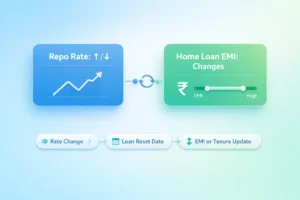
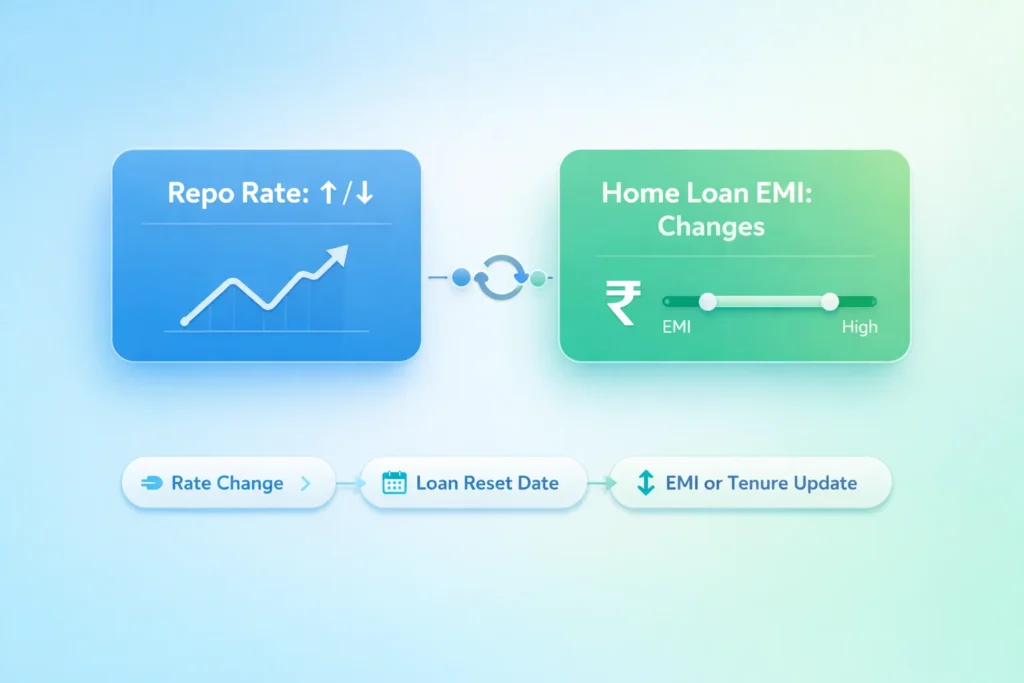
Even if the RBI reduces the repo rate, your EMI may not reduce immediately under MCLR.
Isliye kaafi log bolte hain rate cut ka benefit late milta hai.
What Is RLLR in Home Loans?
RLLR stands for Repo Linked Lending Rate.
Under this system, your home loan interest rate is directly linked to the RBI repo rate.
The formula is simple. The repo rate plus the bank spread equals your loan rate.
This makes RLLR more transparent and predictable.
How RLLR Affects Your Home Loan
Under RLLR
- Rate changes reflect faster
- Repo rate cuts benefit borrowers quickly
- Repo rate hikes also increase EMI faster
There is less discretion with banks in changing rates.
Agar repo rate ghata, EMI jaldi kam hoti hai.
Key Differences Between MCLR and RLLR
MCLR
- Bank-controlled benchmark
- Slower rate of transmission
- Less transparency
- Reset based changes
RLLR
- RBI repo linked
- Faster rate changes
- More transparent
- Direct impact on EMI
Understanding this difference helps you make informed decisions.
Which Benchmark Is Better for Borrowers?
In most cases, RLLR is better for borrowers.
Reasons
- Faster benefit of rate cuts
- Clear formula
- Lower long-term interest in falling rate cycles
However, RLLR also indicates a quicker increase in EMI as rates rise.
When MCLR May Still Make Sense
MCLR may suit you if
- You want stability in EMI
- You do not wish to make frequent changes
- You are close to loan closure
But remember, stability can come at the cost of higher interest over time.
Can You Switch from MCLR to RLLR?
Yes, many banks allow switching.
Before switching, check
- Conversion fees
- New interest rate offered
- Reset period impact
- Long-term savings
Even after paying a small conversion fee, savings can be significant over a long tenure.
Impact on EMI and Loan Tenure
Under RLLR
- EMI or tenure changes faster
- You stay closer to market rates
Under MCLR
- EMI changes slowly
- Tenure often increases silently
Always track how banks adjust EMI and tenure.
Credit Score Angle
Benchmark choice does not directly affect your credit score.
But
- Sudden EMI increase under RLLR can cause missed payments if not planned
- Missed EMIs hurt your credit score badly
Always maintain buffer funds and check your credit score regularly to stay safe.
How to Decide What Is Right for You
Ask yourself
- Do I want the faster benefit of rate cuts
- Can I handle EMI changes
- How long is my loan tenure
If the loan tenure is long, RLLR usually works better. If the loan is nearing the end, the impact is less significant.
Common Mistakes Borrowers Make
- Not checking the benchmark while signing the loan
- Assuming all floating rates behave the same
- Ignoring reset clauses
- Delaying the switch despite a clear benefit
Thoda awareness rakho, long-term savings mil jaati hain.
Final Thoughts
MCLR and RLLR decide how fairly and quickly interest rate changes reach you. In today’s environment, RLLR offers greater transparency and faster benefits but also requires better EMI planning.
Understand your cash flow, loan stage, and risk tolerance before making a decision. Sahi benchmark choose karoge, to home loan journey smooth rahegi.
FAQs
Is RLLR always cheaper than MCLR?
Not always, but over the long term, it usually benefits borrowers more.
Can a bank refuse to switch the benchmark?
Banks may charge a fee, but usually switching is allowed.
Does switching benchmarks affect credit score?
No. It does not affect your credit score.
How often does RLLR change?
Whenever the RBI changes the repo rate.
Which is better for a long-term home loan?
RLLR is generally better for long-term loans.