
Buying an under-construction home is common in India, especially in metro cities where ready properties are expensive. When you take a home loan for such a property, banks usually give you two repayment options during the construction phase. These are Pre EMI and Full EMI.
Many buyers make decisions without fully understanding the differences. That decision can change how much interest you finally pay. Let’s break it down in a simple way.
What Is Pre EMI?
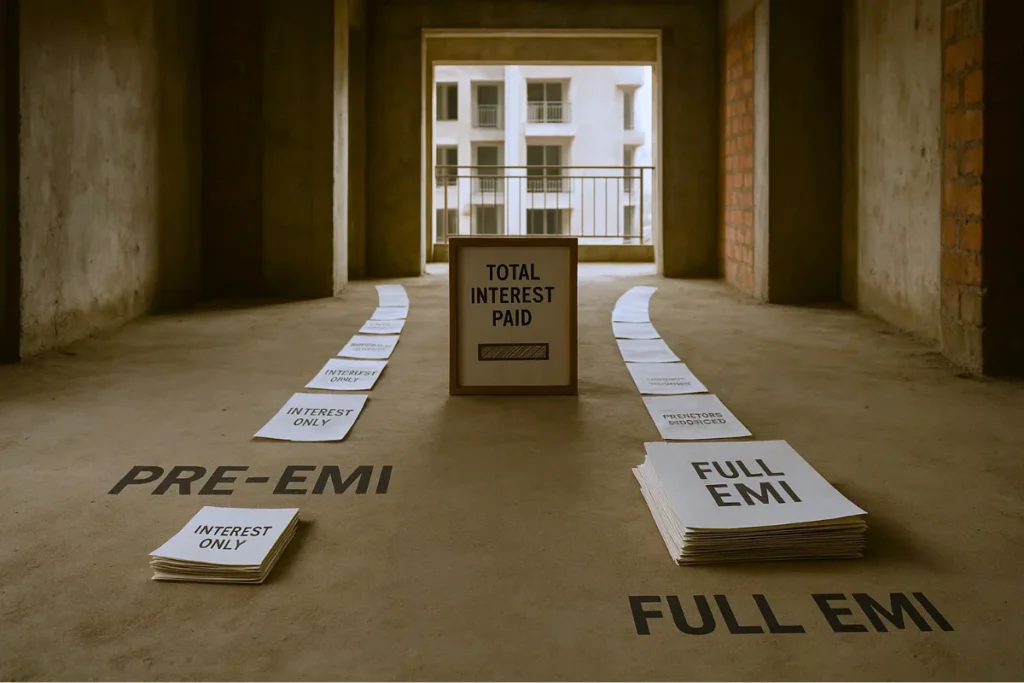
Pre-EMI means you pay only the interest portion of the loan during the construction period.
Banks disburse loans in instalments based on construction progress. You pay interest only on the amount disbursed so far.
Example
Total loan approved ₹60 lakh.
First disbursement ₹10 lakh
You pay interest only on ₹10 lakh, not on the full amount.
Principal repayment starts only after the property is completed and the whole loan is disbursed.
What Is Full EMI?
Complete EMI means you start paying both principal and interest from the beginning, even if the home is still under construction.
In this option
- The EMI amount is fixed from day one
- Principal reduces every month
- Interest outgo reduces over time
Some banks allow this option, while others may offer it only on request.
Key Difference Between Pre EMI and Full EMI
The main difference is when you start repaying principal.
Pre EMI
- Lower monthly payment initially
- Principal repayment starts later
- Higher total interest paid
Full EMI
- Higher monthly payment
- Principal reduces from the start
- Lower total interest paid
Choice depends on your cash flow and long-term planning.
Which Option Saves More Money?
From a pure money perspective, Full EMI saves more.
Why
- Principal reduces earlier
- Interest is calculated on the lower balance
- Total interest over the loan tenure is less
Pre-EMI feels lighter on the pocket initially, but you end up paying interest for a longer time.
Simple maths hai, but impact kaafi bada hota hai.
Example to Understand the Difference
Loan amount ₹50 lakh
Interest rate 9 per cent
Construction period 3 years
Pre EMI option
- You pay interest only for 3 years
- Principal stays the same during construction
- Total interest paid is higher
Full EMI option
- You start reducing the principal immediately
- Interest rates reduce every year
- Overall savings can run into a few lakhs
Exact numbers depend on rate and tenure, but the trend remains the same.
When Pre EMI Makes Sense
Pre-EMI is applicable if
- Your income is tight initially
- You are paying rent and EMI together
- You expect salary growth soon
- You want lower outgo during construction
For many first-time buyers, cash-flow comfort matters more at the outset.
Rent aur EMI saath mein sambhalna mushkil ho sakta hai.
When Full EMI Is a Better Choice
Complete EMI is better if
- You can comfortably afford a higher EMI
- You want to reduce the total interest
- You plan long-term savings
- You want a lower loan burden later
If rent is not an issue or income is stable, paying the complete EMI is financially smarter.
Tax Benefit Angle in India
Pre-EMI interest can be claimed for tax benefits, but only after possession.
Interest paid during construction is allowed in five equal parts starting from the year you get possession.
This applies to both pre-EMI and full EMI interest, so tax benefit alone should not be the deciding factor.
Common Mistakes Buyers Make
- Choosing pre-EMI without checking the total interest
- Assuming pre-EMI is cheaper
- Not planning for EMI jump after possession
- Ignoring long-term affordability
- Not reviewing loan terms every year
Small planning mistakes can lead to higher stress later.
How to Decide What Is Right for You
Ask yourself
- Can I afford higher EMI now
- Am I paying rent currently
- How stable is my income
- Do I plan prepayments later
If you can handle higher EMI early, complete EMI usually works better. If cash flow is tight, pre-EMI gives breathing space.
Impact on Credit Profile
Both options are reported to credit bureaus the same way, provided you pay on time.
Missed payments in either option will affect your credit score. So discipline matters more than EMI type.
Track your loan regularly and check credit score updates so you stay in control.
Final Thoughts
Pre-EMI and full EMI are neither inherently good nor bad. They suit different financial situations.
Pre-EMI gives short-term relief. Complete EMI offers long-term savings. Choose based on your income, rent situation, and plans. Thoda planning aaj, to loan ka stress kal kam.
FAQs
Is pre-EMI cheaper than full EMI?
No. Pre-EMI usually results in higher total interest.
Can I switch from pre-EMI to complete EMI?
Yes, many banks allow switching during construction.
Does pre-EMI affect tax benefits?
No difference in total benefit, but the claim starts after possession.
Which option do banks prefer?
Banks do not have a preference as long as payments are regular.
Should first-time buyers choose pre-EMI?
Only if cash flow is tight initially; otherwise, the full EMI is better.