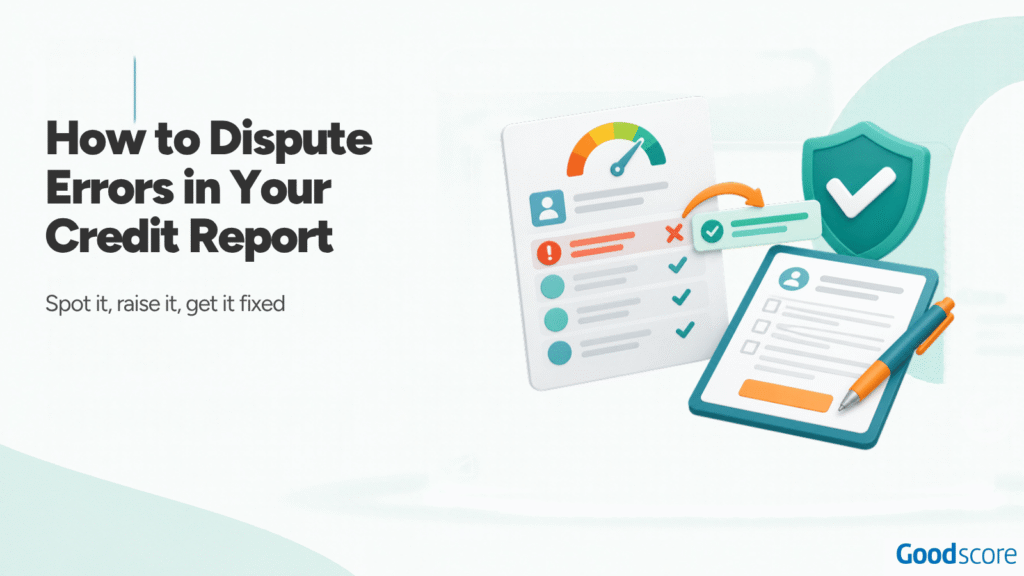
Is your credit score dropping despite you maintaining disciplined financial behaviour? Then there could be an error in your credit report that might be affecting it negatively. Spotting an error and raising a dispute online with the credit bureau is the only way to tackle this situation
Once you identify the error in your credit report, raise a dispute online with the credit bureau that shows it, or complain to the lender that reported the data. Attach proof, note your dispute ID and track it. Under RBI rules, the complaint should be resolved within 30 days, and you are entitled to ₹100 a day for any delay beyond that.
There are two ways to get the error corrected in your credit report:
Through the credit bureau: TransUnion CIBIL, Experian, CRIF High Mark and Equifax each have a dispute process. The bureau checks with the lender that reported the data and updates your report if the lender confirms the correction.
Through the lender: the bank or NBFC that reported the data can correct it directly and send the update to every bureau.
Common Errors Found in Credit Report
| Error type | Example | Where to fix it |
| Wrong personal details | Misspelt name, wrong date of birth, old address, wrong PAN | Bureau, with ID proof. The lender too, if it reported the wrong details |
| Account that is not yours | A loan or card you never applied for | Bureau and lender. Treat it as possible fraud |
| Closed loan showing active | A repaid loan still shows an outstanding balance | Lender first, then bureau, with your NOC |
| Wrong late payment or DPD | An EMI you paid on time shows as 30 days past due | Lender first, with payment proof, then bureau |
| Wrong status | A loan you repaid in full shows as settled or written off | Lender, with closure documents, then bureau |
| Duplicate account | The same loan appears twice, doubling your debt | Bureau, which checks with the lender |
| Unauthorised enquiry | A credit enquiry from a lender you never applied to | Bureau, and the lender that made the enquiry |
Proofs to Collect Before Filing the Dispute
Having clear proof of the mistake makes it easier for the lender to confirm the error and also helps in expediting the correction process. Below is the list of documents that you should have ready before raising an official complaint.
- A copy of the credit report with the error marked, including the report date and any reference or control number on it
- Loan or credit card statements covering the period in question
- The NOC, no-dues certificate or closure letter, for a closed or settled account
- Payment receipts or bank statement entries, for a wrong late payment
- ID and address proof, for errors in personal details
- Any emails, letters or complaint reference numbers from the lender
Keep copies of everything you submit and note the date you submitted it.
How to raise a dispute with each bureau
Each bureau keeps its own file, so raise the dispute with every bureau whose report shows the error. The steps below were taken from each bureau’s published process, terminology and process to raise a dispute may vary from bureau to bureau.
CIBIL
- Log in to your myCIBIL account on the TransUnion CIBIL website, or create one.
- Open your credit report and go to the Dispute Centre.
- Choose the section that is wrong, such as personal information, account information or enquiry information, and select the specific item.
- Describe the error, enter the correct details, attach your proof and add your bank account details for any compensation.
- Submit the dispute and note the dispute ID. Track it under the dispute status section of your account.
Experian
- Log in to your Experian credit profile and select Dispute, then Raise A Dispute. Experian also publishes a direct dispute link that does not need an account.
- Enter the Experian Reference Number (ERN) shown on your report and the Unique Transaction ID (UTI) from Experian’s email. If these are more than 30 days old, fetch a fresh report first.
- Choose the dispute type: account details, personal details or credit enquiry.
- Enter the correct information next to each item you want changed, review it, add your bank details if asked, and submit.
- Experian sends an acknowledgement by email. Track the dispute under Track dispute in your account.
CRIF High Mark
- Log in to the CRIF High Mark personal credit report portal.
- Go to My report and open the Raise a Query tab.
- Select the report you want to dispute and click Proceed.
- Choose the account or information to correct, describe the change and submit.
- CRIF High Mark emails you a service request number. Use it to follow up.
Equifax
- Go to the Equifax India website and find the Dispute Resolution Form under the forms section.
- Download and fill in the form, describing the error and the correct details.
- Attach self-attested copies of your ID proof, address proof and any supporting documents.
- Email the form and documents to Equifax’s customer support address, or post them to its Mumbai office. Both are listed on the Equifax India website.
- Keep the acknowledgement and use it to follow up with customer support.
Raise Dispute Directly with the Lender
The lender is the source of the data on your report, so going to it directly is often the fastest way to fix an error in an account’s status, balance or payment history. Once the lender corrects its records, it sends the update to all four bureaus, so you do not need to repeat the process with each one. Bureau disputes are still useful for errors in personal details, duplicate accounts and enquiries, but if there is error in reporting related to your accounts then reaching out to the lender directly is a more practical approach.
Write to the lender’s customer care by email or through its app, attach your proof and ask for a complaint reference number. If you get no satisfactory response, escalate to the lender’s grievance redressal officer and then its principal nodal officer, whose details are published on the lender’s website.
Under RBI’s framework, once the lender is told about the error, by you or by a bureau, it has 21 calendar days to send corrected data to the bureaus.
How long it takes and what RBI requires
RBI’s compensation framework for credit information complaints sets these rules for lenders and bureaus:
- The complaint should be resolved within 30 calendar days of when you first filed it with the lender or the bureau.
- Within that period, the lender has 21 days to send corrected data, and the bureau has the rest of the time to update your report.
- If the complaint is not resolved within 30 days, you are entitled to ₹100 for each calendar day of delay. The lender pays if it missed its 21 days, the bureau pays if the lender met its deadline and the bureau did not, and the cost is shared if both were late.
- Compensation is credited to the bank account you gave when filing, within five working days of resolution.
- If your complaint is rejected, you must be told the reasons.
Some complaints are excluded, including disputes about how a credit score is calculated and matters already before a court or consumer commission. A complaint is treated as resolved when the corrected report is sent to you, so download a fresh report to confirm the change.
If your dispute is rejected
A rejection usually means the lender has told the bureau that its data is correct. Verify the reason given, then decide whether you have evidence that shows otherwise.
- Go back to the lender. Write to the grievance redressal officer with your evidence and the reason for rejection and ask for a specific response .
- Escalate within the lender. If the grievance officer does not resolve it, write to the lender’s principal nodal officer.
- Complaint to the RBI Ombudsman. If the lender or bureau does not reply within 30 days, rejects your complaint or you are not satisfied with the reply, you can file a complaint under the Reserve Bank Integrated Ombudsman Scheme, 2021 at cms.rbi.org.in. The scheme covers banks, NBFCs and credit information companies. You must file within one year of the reply, or within one year and 30 days of your original complaint if there was no reply.
Need help with a dispute? GoodScore can help you raise and track disputes with the credit bureaus. Download GoodScore App now.
FAQs
You can dispute any information that is inaccurate. Common examples are wrong personal details, accounts that are not yours, a loan shown as active after closure, wrong late payments or days past due, a wrong status such as settled instead of closed, duplicate accounts, and credit enquiries you did not authorise. Accurate information cannot be removed through a dispute.
Log in to your myCIBIL account, open your credit report and go to the Dispute Centre. Select the section and the item that is wrong, describe the error, attach your proof and submit. You will get a dispute ID to track progress. Experian, CRIF High Mark and Equifax each have their own process, set out above.
Yes. You can raise a dispute directly with a credit bureau or with your lender without paying for it. You do not need an agent or paid service to do it. Complaints to the RBI Ombudsman are also free. Be cautious of anyone who charges to remove information from your report.
Under RBI’s framework, a complaint should be resolved within 30 calendar days of when you first raised it. The lender has 21 of those days to send corrected data. If the complaint takes longer than 30 days, you are entitled to compensation of ₹100 for each day of delay, credited within five working days of resolution.
No. Raising a dispute does not affect your credit score. Your score changes only if the dispute leads to a correction in your data. If the error was hurting your score, for example a late payment that was not late, the correction may improve it. If the dispute is rejected, your score stays as it was.
You must be told the reason for the rejection. If you have evidence that the data is wrong, write to the lender’s grievance redressal officer, then its principal nodal officer. If that does not resolve it, file a complaint with the RBI Ombudsman at cms.rbi.org.in, which covers both lenders and credit bureaus.
Each bureau keeps its own file, so raise the dispute with every bureau whose report shows the error. If the lender corrects the data at source, it sends the update to all bureaus, which can save effort. Where several lenders are involved in one complaint, the bureau coordinates with each of them.
You can authorise someone else, including a service provider, to raise a dispute on your behalf. Be careful about sharing personal and financial data, and check what you are agreeing to. No third party can remove accurate information. GoodScore offers paid help with disputes, and you can also raise one yourself for free.
Treat it as possible fraud. Tell the lender in writing that the loan is not yours, raise a dispute with every bureau that shows it, and report it on cybercrime.gov.in or at a police station. Keep copies of every complaint and reference number, and keep checking your report until the account is removed.
No. A dispute can only correct information that is wrong or out of date. Accurate entries, such as a payment you genuinely made late or a loan you settled, stay on your report. Anyone who promises to delete accurate records is misleading you. What helps over time is a steady record of on-time payments.