
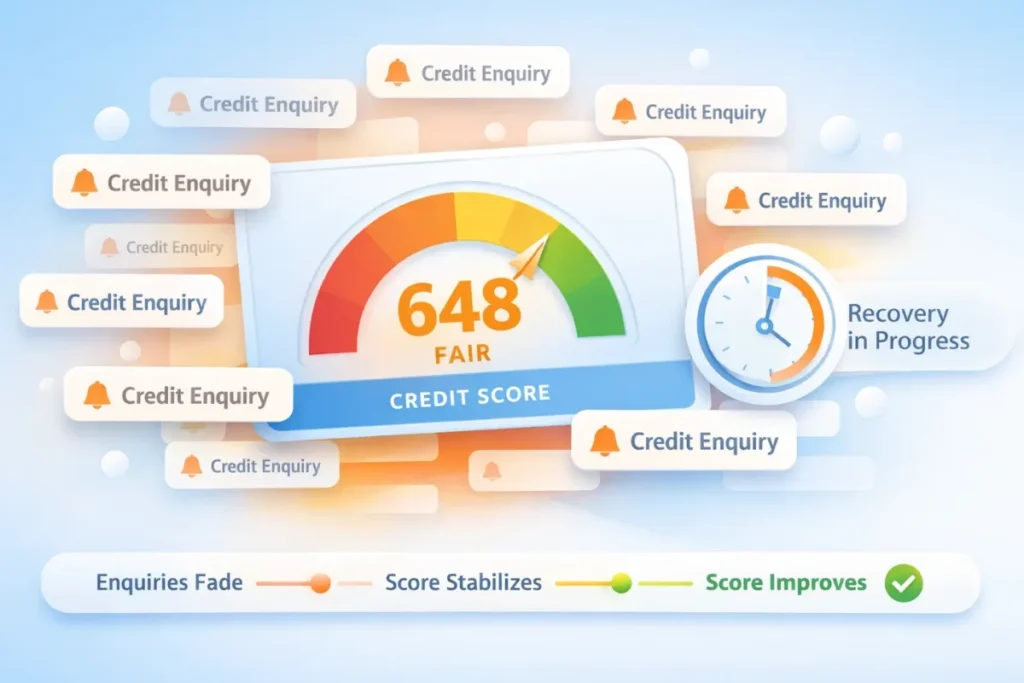
Too many credit enquiries can pull your score down and make banks think you are desperate for credit. The good news is it’s fixable if you pause and plan.
What is a credit enquiry?
Whenever you apply for a loan or credit card, the lender checks your credit report. That check is called a credit enquiry. There are two types:
- Hard enquiry: happens when you apply for credit. This can affect your score.
- Soft enquiry: occurs when you check your own score or when a lender conducts a pre-check. This usually does not affect your score.
This article is about hard enquiries, because that’s what causes trouble.
Why do too many enquiries reduce your credit score
A few enquiries are normal. But many enquiries in a short time signal risk. From a lender’s view, it can mean:
- You are trying multiple lenders because you’re not getting approved
- You might be taking on more EMIs than your income can handle
- You may be facing a cash crunch
Credit scoring models also treat high recent enquiries as higher credit risk, so the score may dip for some time.
How many enquiries are “too many”
There’s no fixed RBI number like “after 5 you’re in trouble”. But in real life, these patterns start hurting:
- 3+ hard enquiries in 30 days for similar products (like personal loans or cards)
- Multiple enquiries across different lenders within 2–4 weeks
- Applying right after a recent loan disbursal
One enquiry rarely hurts much. Multiple enquiries stacked together are what causes impact.
How long does it take to recover
Most enquiry-related impact is short-term. In many cases:
- The score dip is seen within a few days to a couple of weeks
- Recovery often starts in 1–3 months if you stop applying and keep payments clean
- Enquiries remain visible on your report longer, but their impact reduces over time
Think of it like this: the enquiry is a “signal”, but your repayment behaviour is the “proof”. If your EMIs and card payments stay on time, the proof wins.
The bigger hidden problem: rejection and over-borrowing
Enquiries become worse when combined with:
- loan rejections
- high credit card utilisation
- missed EMIs or bounced payments
- already high EMI burden
If you keep applying to the same bank after a rejection, pause. Repeated attempts can increase the likelihood of the next rejection.
What to do if you already have too many enquiries
1) Stop new applications for 60–90 days
This is the fastest way to stabilise the score. No new loans, no new cards, no “just checking eligibility” that triggers a hard enquiry.
2) Reduce credit card utilisation
If your card limit is ₹1 lakh and your statement shows ₹70k used, reduce it. Try to keep utilisation under 30% if possible. This often improves your profile faster than any other approach.
3) Pay before the due date, not on the last day
Late payments hurt far more than enquiries. If you’re rebuilding, keep repayments boring and on time.
4) If you must apply, apply smart
- Apply to one lender at a time
- Prefer pre-approved offers shown inside your bank app (often fewer checks)
- Don’t apply for both a card and a personal loan in the same week
Thoda patience rakho. One good approval is better than five random attempts.
How to avoid too many enquiries in future
- Compare eligibility and rates first, then apply once
- Avoid multiple “instant loan” links and pop-ups
- Don’t apply just because someone said “free card mil jayega”
- Keep one primary credit card, and don’t chase too many new limits
If you want to track enquiries and spot mistakes early, regularly check your credit score and look at the “enquiries” section.
FAQs
1) Do all enquiries reduce credit score?
No. Hard enquiries can reduce it. Soft enquiries usually do not.
2) How many enquiries are acceptable?
No fixed number, but 1–2 in a short period is usually fine. Too many back-to-back enquiries can hurt.
3) How long do enquiries stay on the credit report?
They remain visible for a while, but their impact on your score declines over time, especially if you stop applying.
4) Can I remove enquiries from my credit report?
Genuine enquiries cannot be removed. Only incorrect or fraudulent enquiries can be disputed.
5) Will a single rejected loan application hurt my score?
A rejection is not shown; however, the hard enquiry is recorded. One enquiry usually has a small impact. Repeated applications create the problem.