
Paying only the minimum due on your credit card feels like a quick fix. But it can quietly become expensive and can also affect your credit score over time. Here’s the simple breakdown so you can decide what to do.
Credit card minimum due vs full payment: what’s the difference?
What is the minimum due?
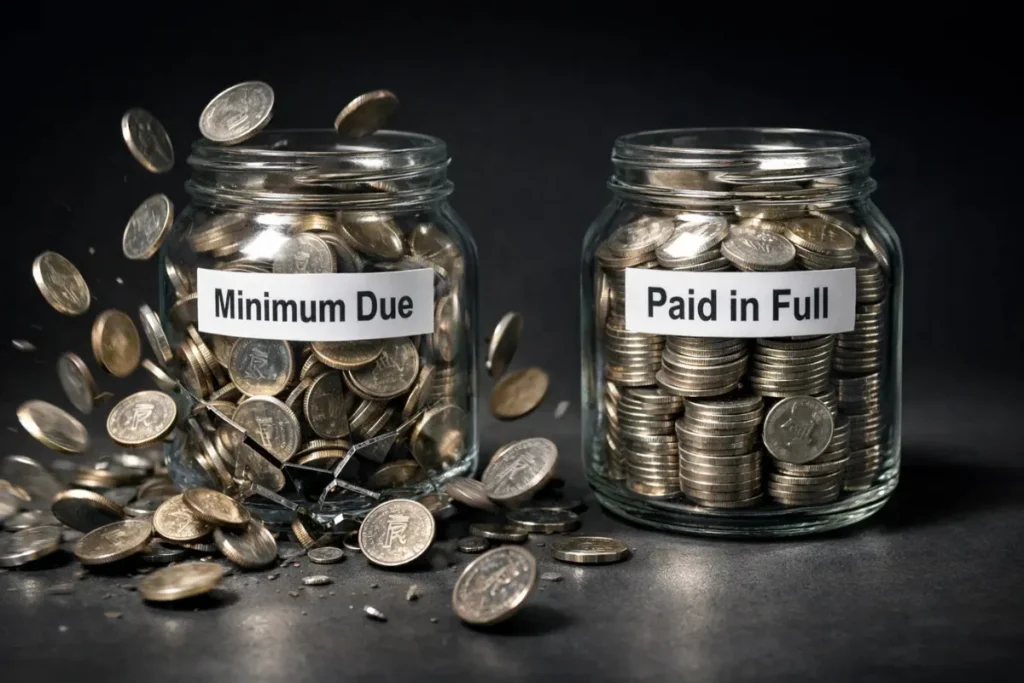
Minimum due is the smallest amount you must pay to avoid your card being marked as “missed payment” for that month. It is usually a mix of a small portion of your bill and any charges, such as a late fee, EMI amount (if any), and taxes.
What is full payment?
Full payment means paying the total amount due shown on your statement before the due date. This helps you avoid interest on purchases (as long as you are within the interest-free period and not carrying an old balance).
Why does the minimum due become expensive?
When you pay the full amount, you usually pay zero interest on purchases.
When you pay the minimum due, the remaining balance begins to accrue interest. And here’s the part many people miss: interest can be charged from the transaction date, depending on the card rules and whether you are carrying forward an older balance.
Simple example
Priya’s credit card bill is ₹30,000. Minimum due is ₹1,500.
She pays ₹1,500 and carries ₹28,500 forward.
If the card’s monthly interest is around 3% (varies by card), then next month’s interest alone can be roughly:
₹28,500 × 3% = ₹855 (approx)
Now imagine she repeats this for a few months. The interest keeps piling up, plus GST on interest, and the bill becomes hard to control. That’s how people fall into the “minimum due trap”.
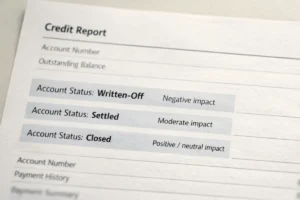
Does paying the minimum due affect your credit score?
1) Payment history
Paying the minimum due is still considered an “on-time payment” in many cases, so it may not immediately harm your score as a missed payment would. But it doesn’t mean it’s healthy.
2) Credit utilisation
If you keep carrying balances, your utilisation stays high. Example: limit ₹1,00,000 and outstanding ₹70,000 means 70% utilisation. High utilisation can pull your score down even if you pay on time.
3) Debt stress signal
Carrying a balance month after month tells lenders you might be stretched. When you later apply for a loan, your profile can look risky because your monthly obligations feel higher.
If you want to keep an eye on these signals, you can check your credit score regularly and look at utilisation and repayment patterns.
What should you do if you can’t pay the full amount?
Best option
Pay the full amount due before the due date. This keeps interest at zero and keeps your credit profile clean.
If you cannot pay the full amount this month
Do this instead of just paying the minimum due:
- Pay the minimum due first to avoid late payment
- Pay as much extra as possible within the same month
- Stop new spending on the card until the balance reduces
- If the balance is big, consider converting only the remaining amount into EMI if it genuinely reduces interest, and you can handle EMIs comfortably
Haan, it’s a bit painful for one month, but it prevents a long-term mess.
When is it okay to pay only the minimum due?
Paying the minimum due can be acceptable as a temporary emergency measure, such as to cover medical expenses or a salary delay. But it should be a one-time bridge, not a monthly habit. Bas itna rule rakho: next month full payment plan banao and reduce usage until you catch up.
How do you avoid the minimum due trap?
- Keep utilisation under 30% when possible
- Pay the full amount, not just the minimum due
- If you must revolve, make a clear 2–3 month payoff plan
- Avoid multiple card EMIs together if cash flow is tight
FAQs
Does paying the minimum due affect my credit score immediately?
Not always. It may still count as on-time, but carrying a high balance can hurt your score through high utilisation.
Will I be charged interest if I pay the minimum due?
Yes. Interest is charged on the unpaid balance, and it can add up fast over months.
Is it better to convert my balance to EMI?
Sometimes. It can help if the EMI interest is lower and you stop fresh spending. Otherwise, it becomes double pressure.
What happens if I pay less than the minimum due?
That can be treated as a missed payment and may lead to late fees and negative reporting.
What is the smartest move if I’m stuck in a revolving balance?
Pause card usage, pay more than minimum every month, and aim to clear in 2–3 months. If it’s too large, consider consolidation only if it reduces total cost.